skip to main |
skip to sidebar
U.S. Senator Edward Kennedy returned to Congress on July 9th without his dogs, Sunny and Splash. Sen. Kennedy was determined to be present to vote "Aye" on a healthcare bill to block a 10% cut in Medicare payments to doctors.
Sunny and Splash must miss wandering around Capitol Hill as much as the senator does. Whether you love Sen. Kennedy or not, two things are clearly loved by the senator: his Portuguese Water Dogs and his congressional work.
People who remember the JFK era probably watched the broadcast of Sen. Kennedy's July 9th Capitol appearance with some emotion. His niece "little" Caroline was accompanying him. In 1963, people say, TV networks around the world showed young Caroline accompanying her mother, the late Jackie O, to her father's funeral services.
All of the third-generation Kennedys are gone now except Sen. Ted and sister Eunice Kennedy Shriver, who in 1968 founded Special Olympics. Earlier this year, Congress honored her by renaming NICHD the Eunice Kennedy Shriver National Institute of Child Health & Human Development.
I guess these two humans have always liked kids and dogs. As Sen. Kennedy told the Washingtonian in 2006, "Splash sat through the markup for the 'No Child Left Behind Bill'." Sunny and Splash got to attend many important congressional meetings when they weren't sleeping under the senator's desk.

Nowadays Sunny and Splash just hang out in Cape Cod waiting for legislative action. At least they got in a little sailing the day their senator came home from the hospital.
I wonder whether Splash is working on another book like the children's book he wrote with Senator Kennedy. He called it My Senator and Me: A Dog's-Eye View of Washington, D.C. I heard he could use a few paw tips about storytelling, but he means well. As does Ted Kennedy, I spoze.
Hey dogs! Here's some summer fun you can take your people to: Outdoor movies in Petaluma parks! The film fun begins this week on July 12 with Bee Movie, at McNear Park, 11th & G Streets. The movie starts at 8:45 P.M. You can get there as early as 4:30 to put out your blanket. Or maybe at 6:30 when the food goes on sale.
Another movie series begins at Prince Park, 2301 E. Washington St., on July 26 with a showing of Nacho Libre.
I was howling happy when Robin Harrigan, producer of Movies in the Park, explained the dog pawlicy to me: "If you're a friendly-type dog and promise not to bite, pee on blankets, or cause a ruckus, then you're welcome at Movies in the Park." Woof!
Ms. Harrigan's Shitzu, Beau, offered some helpful tips: If you get tired of a movie at McNear Park, you can "take time for relaxation and reflection in the car, under the shade trees. . . . [Dogs might not want to] attend the movies at Prince Park since there isn't much shade available there." 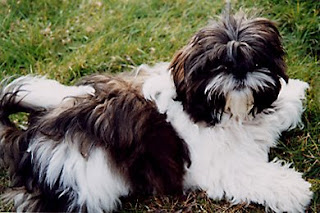
I believe Beau's more interested in the aesthetics of trees than in being the Jan Wahl of dogs. What impresses me is Beau's smarts about knowing his limits in the heat and sun. Which reminds me, we should take our water bottles, and maybe cooling vests and mats — though Petaluma evenings are known to be cool.If you're a real film buff, you might want to spend the whole movie dogging your person's blanket, riveted to the big screen. Better take your dog snacks, or else you'll be tempted to snag people's popcorn, pizza, or ice cream — just some of the goodies sold before the movies start.
Pant alert: BBQ or hot dogs will be sold at some showings.
All this fun for a small suggested $4 adult human/$2 kid donation at the door. (Parks have doors? Would they be "out"doors?) You're entered to win prizes when donation is paid at the "out"door. People interested in being a sponsor or an on-screen advertiser can email info@petalumamovies.com, or call 707-694-9888.
The Movies in the Park website www.petalumamovies.com has complete schedules and info for both series, which run until almost the end of September. You can also call for info at 707-694-9888.Shouldn't a town named PETaluma be the furfect host for dog-friendly events?
Wine country summertime means outdoor concerts, and this means humans have to protect little ears from loud music. My dog-ma makes me howl when she tells me about seeing puppies and human babies at these venues (where dogs aren't usually allowed "because of the food").
I asked veterinarian Jona Sun Jordan, DVM, to put this topic in pawspective. You can find Dr. J and her caring staff at Coddingtown Veterinary Clinic in Santa Rosa, California. I like that Dr. J practices Eastern holistic medicine, including TCM and nutritional and herbal therapy, along with Western medicine.
Dr. J says, "Young pet and human ears are especially sensitive to intense sound. Exposure to continued or impulse noise above a certain level — about 100 decibels — can cause pain to little ones and even instantaneous hearing damage. Sound level at a concert can reach 115 to 120 decibels, the pain threshold for the average human adult."
How can a human stand music this loud at a concert? Dr. Jordan explains, "When a person has been enjoying alcohol or other substances, their sense of hearing is dulled. This means that dangerously loud music may not sound all that loud to them. To be safe, little ones should have the appropriate protection at a concert even if the adults don't think the music sounds loud."
So, when pets, kids, and babies are near big stage speakers, it's like they're standing next to someone firing a rifle — only it's worse, because speakers get louder with sudden feedback blasts or when accidentally turned up.
Dr. Jordan adds, "I know of one case where a boy lost his hearing during a loud concert. He was lucky and most of his hearing returned after a few months, but it was a scary time for him and his family."
Here are simple paw points for protecting ears:
1) If it seems loud to you adult humans, it's too loud for pets and children, and damaging to ears of human babies and animal babies.
2) All concerts are too loud, period. There's no "safe" concert for pets and little ones to attend. Not unless they remain way in the back of the audience and also far away from any back speakers.
3) Little ones need earplugs to be safe around any potential loudness. You can make or buy earplugs for pets and kids. Get them to practice wearing earplugs before they need to.
4) Consult your healthcare professionals. It takes skill to plug little ears effectively and safely, especially itsy bitsy baby ears. Your veterinary and pediatric humans would be pawsitively pleased to help protect little ears!
5) Have fun, and take me next time.
The 4th of July holiday isn't over for this dog. I need more picnics and food. I need hot dogs — not the kind that the National Hot Dog and Sausage Council says Americans eat 150 million of every July 4th. I need Franktitude salmon dogs on whole-grain buns. Dog-ma can have the pickles.
Dream on. I can't have Franktitude dogs from Florida. I'm into the local food thing. I'm a REGIONAVORE.
Not a locavore. Locavorism, started in San Francisco, is about drawing the line at 100 miles food-wise — eating only foods grown or harvested within a 100 mile radius of San Francisco. This means you can mostly forget wild salmon. And no more Rogue or Deschutes ales, you guys. Why do locavores think that the San Francisco Bay Area is an economically sustainable bioregion? . . .
In Sonoma County, we have an upscale green grocer who's advertising "Eat 150." Just nudge the locavore line and resize our map. Woof? I already eat local farm market veggies, local cage-free eggs, and local poultry. My dog-ma eats other local stuff, too, like local honey and Redwood Hill Farm goat milk yogurt and cheese.
But let's not be loca-loco. Would you disregard our interdependence with all dogs and humans and other living creatures — including fish and trees — in the greater Pacific Bioregion? You know it's 650 miles to Portland, another 175 to Seattle, and yet another 1,100 miles to Ketchikan. You try telling folks in Alaska they'd better relocate down here 'cuz you don't support trade with them anymore. And tell your friends in, say, Seattle or Portland that you don't support their food entrepreneurialism either. . . . So the heck with the fishing industry, the heck with regional trade altogether?
I'm not going to take my paw and redraw the line again here. Being frank, I'm just going to mention a reasonable regional framework for green food trade. Think of our eating community as a socioeconomic bioregion. Think of it as an adaptation of a natural bioregion extending from Baja to Alaska and including coastal lands and rivers and off-shore waters of the Pacific. This is a concept akin to Salmon Nation: our boundaries defined as "anywhere Pacific salmon have ever run." Quoting from Salmon Nation: "In search of a regional icon — or of a single indicator by which to measure regional health — one could hardly do better. Not only do 137 species depend on salmon as part of their diets, the landscape itself is nourished by them. 'The forest raises the salmon,' writes Richard Manning in his essay The Forests that Fish Built, 'but the salmon also raise the forest. This mutual dependence is the very definition of community, and in the end, the heart of the matter.'"
The heart of the matter. Supporting low-carbon footprint trade without leaving the regional little guys out in the cold. Pass the locally-grown mustard for my nutritious Wild Salmon Club sandwich. Hot diggity dog.


