December 31, 2011

Another year gone

postedby winecountrydog Tilin Corgi

Humans say that another year has gone by. This does make one's old dogself feel contempawlative.


Our best wishes to you for the coming year, dear furriends!

November 1, 2011

Rachel Carson, naturalist ... and Scomber, mackerel under the sea-wind

by winecountrydog Tilin Corgi (with notes from Mum)

Upawn this occasion, the 70th anniversary of the 1941 publication of Under the Sea-Wind, Rachel Carson's first book, we are asked by Mum to paw-write a bit. As you doo know, Rachel L. Carson was a zoologist and naturalist whose last book, Silent Spring, published in 1962, awakened humans to the need to address environmental degradation.

Under the Sea-Wind, in Rachel Carson's words, is "a series of descriptive narratives unfolding successively the life of the shore, the open sea, and the sea bottom."

Under the Sea-Wind: A Naturalist's Picture of Ocean Life. New York: Simon and Schuster, 1941. 1st Edition.

The following excerpt is from "Birth of a Mackerel" -- in which Ms Carson wrote about the first days of Scomber's life. May this "wet" your appetite for devouring the whole book.
The life of the open sea -- miles beyond sight of land -- is various, strangely beautiful, and wholly unknown to all but a fortunate few. Book Two is the story of a true sea rover -- a mackerel -- from birth in the great ocean nursery of the surface waters . . . to membership in a wandering school of mackerel subject to the depredations of fish-eating birds, large fishes, and man.

Between the Chesapeake Capes and the elbow of Cape Cod . . . in the blue haze of the continent's edge, the mackerel tribes lie in torpor during the four coldest months of winter, resting from the eight months of strenuous life in the upper waters. On the threshold of the deep seas they live on the fat stored up from a summer's rich feeding, and toward the end of their winter's sleep their bodies begin to grow heavy with spawn.

In the month of April the mackerel are roused from their sleep as they lie at the edge of the continental shelf, off the Capes of Virginia. Perhaps the currents that drift down to bathe the resting places of the mackerel stir in the fish some dim perception of the progress of the ocean's seasons -- the old, unchanging cycle of the sea. For weeks now the cold, heavy surface water -- the winter water -- has been sinking, slipping under and displacing the warmer bottom water. The warm water is rising, carrying into the surface rich loads of phosphates and nitrates from the bottom. Spring sun and fertile water are wakening the dormant plants to a burst of activity, of growth and multiplication. Spring comes to the land with pale, green shoots and swelling buds; it brings to the sea a great increase in the number of simple, one-celled plants of microscopic size, the diatoms. Perhaps the currents bring down to the mackerel some awareness of the flourishing vegetation of the upper waters, of the rich pasturage for hordes of crustaceans that browse in the diatom meadows and in their turn fill the water with clouds of their goblin-headed young.

. . .

Perhaps, also, the currents moving over the place where the mackerel lie carry a message of the inpouring of fresh waters as ice and snow dissolve in floods to rush down the coastal rivers to the sea. . . . But however the feeling of awakening spring comes to the dormant fishes, the mackerel stir in swift response. Their caravans begin to form and to move through the dim-lit water, and by thousands and hundreds of thousands they set out for the upper sea.

. . .

In time the shoreward-running mackerel reach the inshore waters, where they ease their bodies of their burden of eggs and milt. . . . There are known to be hundreds of millions of eggs to the square mile . . . hundreds of trillions in the whole spawning area.

. . .

So it came about that Scomber, the mackerel, was born in the surface waters of the open sea, seventy miles to the south by east from the western tip of Long Island. He came into being as a tiny globule no larger than a poppy seed, drifting in the surface layers of pale-green water. The globule carried an amber droplet of oil that served to keep it afloat and it carried also a gray particle of living matter so small that it could have been picked up on the point of a needle. In time this particle was to become Scomber, the mackerel, a powerful fish, streamlined after the manner of his kind, and a rover of the seas.

. . .

In the first night of their existence more than ten out of every hundred mackerel eggs either had been eaten . . . or, from some inherent weakness, had died. . . .

. . .

The floating mackerel eggs were scattered and buffeted. . . . Again the egg that contained the embryonic Scomber had drifted unscathed while all above him other eggs had been seized and eaten.

. . .

. . . the surface currents of the sea were pouring steadily to the southwest, driven by the wind and carrying with them the clouds of plankton. During the six days since the spawning of the mackerel the toll of the ocean's predators had continued without abatement, so that already more than half of the eggs had been eaten or had died in development.

. . .

On the sixth night after the spawning of the mackerel the tough little skins of the eggs began to burst. One by one the tiny fishlets, so small that the combined length of twenty of them, head to tail, would have been scarcely an inch, slipped out of the confining spheres and knew for the first time the touch of the sea. Among these hatching fish was Scomber. . . .
An unfinished story, the ending for which awaits you in this beautiful book. Under the Sea-Wind is still in print and is unmatched in its sensitive, accurate observations of sealife.

Rachel Carson was born in 1907 and grew up in the lower Allegheny Valley of Pennsylvania. She was quoted as saying "I can remember no time when I wasn't interested in the out-of-doors and the whole world of nature."

She spent important college summers studying at Woods Hole Oceanographic Institution in Massachusetts. In 1935, during the Great Depression, Ms Carson took a position at the Bureau of Fisheries in Washington -- one of two federal agencies that were merged into the U.S. Fish and Wildlife Service in 1940. As an agency biologist and publications editor, she was one of the first two women to be hired by FWS for a non-clerical position. Rachel Carson lived only until 1964, two years after Silent Spring.


Ms Carson's biographer and editor Paul Brooks pointed out that "Though Rachel Carson's last book, Silent Spring, may have changed the course of history, she was not at heart a crusader. . . . In her intense feeling for man's relationship to the living world around him, she was ahead of her time. When she began writing, the term 'environment' had few of the connotations it has today. Conservation was not yet a political force. To the public at large the word 'ecology' -- derived from the Greek for 'habitation' -- was unknown, as was the concept it stood for. This concept, however, is central to everything that Rachel Carson wrote."

Toward the end of Ms Carson's 56 years, when she was ill, it is said that "she liked to be read to. One of her favorites was Wind in the Willows. Then anything of E.B. White's -- also H.M. Tomlinson, Richard Jeffries, Henry Beston. . . ." We mention this 'cause Mum, who has always been drawn to the sea and draws meaning from Ms Carson's writings, loves all of these writers.

One is indebted to the late esteemed editor Paul Brooks, whose 1972 biography The House of Life: Rachel Carson at Work, provides the above insights and quotes. Mum suggests this volume as an important, outstanding portrait of Rachel Carson and her work.

October 21, 2011

"Fellow prisoners of the splendour and travail of the earth"

by winecountrydog Tilin Corgi

Someone said 58 billion animals are killed in factory farms and slaughterhouses every year. Whether or not tis accurate number, following are real numbers from NASS for just one month of commercial U.S. "livestock" slaughter. And only for red meat, as the number of hogs slaughtered is not included ere:
"Commercial red meat production for the United States [in August 2011] totaled 4.30 billion pounds  ... Cattle slaughter totaled 3.10 million head ... Calf slaughter totaled 79,900 head. ... Sheep slaughter totaled 198,200 head. ..."
Did any of these millions of animal furriends live pleasant pastoral lives or die a peaceful death?

Here is extreme pawsitive contrast: the practices of farmer and Border Collie lover Elissa Thau, an artisanal meat producer in Umpqua Valley who raises and slaughters sheep humanely. You will see in this video howl carefully and lovingly tended are all the animals on her farm.

Wot a grrreat video. Ms Thau first introduces you to her beloved Border Collie working dogs. Then she talks about her philosophy of raising and respecting animals.


We must paw-point to some highlights of wot Elissa Thau has said:
"The [Border Collie] is bred as a working dog. ... They're an incredible working partner. It's a real privilege to work with a dog. ... And our dogs all live in the house. ... My mum used to say 'They'll never work if you spoil them like that' 'cause she was from an old farming family in England. ... In the UK ... it's really an art ... among the old shepherd and farmers.

"The dogs don't need to bite to move sheep. ... They move sheep with the power of their eye and their presence ... and the fact they have quiet power.

"... And the whole point of raising sheep the way that we raise them it is to raise them quietly and humanely. . . .

"It's a hard thing to kill a lamb or a cow. ... We actually take ours down to the butcher, and then they're killed there quickly and humanely. . . .

"It's a very serious thing to kill an animal. ... People should take it very seriously. They shouldn't be expecting to eat meat seven days a week, two times a day. ... It just becomes agribusiness, greed, and suffering. . . .

"Who wants to eat an animal that's been standing in a feedlot ... through the winter with no shelter . . .? . . . I don't eat any meat that I don't know where it's come from. . . .

"Have you ever read Henry Beston? He wrote [The Outermost House] ... 'Animals are not brethren, they're not underlings, they are other nations, caught with ourselves in this net of life and time, [fellow prisoners of the splendour and travail of the earth.]' And hopefully we treat them that way too."
High paw for Elissa Thau! A gentle, wise, and caring human.

Paw-notes: Thanx woofs to Daniel Klein of The Perennial Plate -- "online weekly documentary series dedicated to socially responsible and adventurous eating" -- for sharing this inspirational interview.

Magnolia Farm is a small family farm in the rolling hills near Riddle, Oregon, in the Umpqua Valley (also known as a wine region), where Elissa Thau, her husband, Mel Thau, and their family of Border Collies have been raising sheep for a couple of decades.

Ms Thau also does Border Collie herding trials. If you are thinking bout getting a BC dog, we doo recommend that you consider the decision carefully and talk to an expert like Ms Thau. Pawleeze note that there are many BCs and other herding dogs in rescue. Humans doo surrender us cuz they find us hard to handle. (Ask furbro Jackie Nippers to tell you bout his own experience.)

Ere is website where you can read bout naturalist and author Henry Beston.

September 24, 2011

"Fine, be that way!" ... the LOL cats

by winecountrydog Tilin

Doo you know the LOLcats? Methinks tis time to share our pawculiar habit of hangin with these kittehs. Ourwoofselves have been fans fur a long time.

And guess wot. Mum is big fan of the LOLcat and does often doo LOLspeak with em. ... Meezer, not so much. Meezer is pawoccupied in the kitchen and in er sculptin studio.

When we doo need laffs, we doo BOL at da LOL piccies. Like this one:

"I said 'What's your name?' ... Fine! Be that way!"

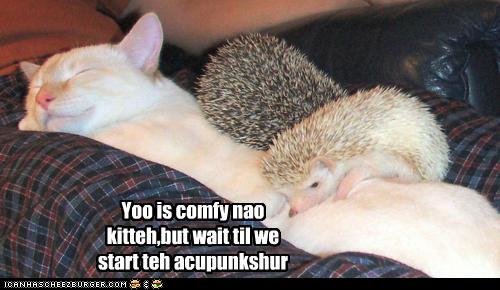
Now here are a pair of LOLhedgehogs. Look at wot they are telling teh comfy sleeping kitteh:


If you did not LOL or BOL, howl, fine, be that way. You are missin da good meme. Methinks your laffer needs tuneup.

Pawleeze, get a laff. Go check out the LOLcats at icanhascheezburger.com.

Paw-note: We doo miss our twitter pal @perrythebirman. That Birman Bond is the best at LOLspeak, but himself furry bizzy and not tweetin enuff. Sigh.

August 23, 2011

Dogs and wine tasting ... not always a good pairing

by winecountrydog Jackie Nippers

Back in his puppyhood, furbro Tilin repawts, he began visiting wineries in Sonoma and Napa, and on the Sonoma Coast and Mendocino County as well. Furbro turns 14 years old during harvest 2011, and is still an active traveler.


Nowadays, furbro is sometimes joined by mywoofself at tastings, where we doo make wine paw-notes while humans have wine sensory adventures.

Over the years, our regional wineries have become furry pawpular. Furbro observes that both the locals who love wine and the happy visitors now enjoy wine tastings all year round. Wine-loving locals, along with visitors from the greater SF Bay Area and around the world, spend many summer days involved in wine touring. Wineries are a grrreat "staycay" destination for locals. And the autumn harvest happenings are becoming wildly pawpular too.

The wine tasting rooms and wine roads have become busy places.

Inside the tasting rooms, furbro and myself, being rawther short in stature, sometimes feel lost amongst the humans, who can move about and wave unpredictably. Above our dogheads, we doo see towering wine bars and shelves full of wine bottles or winery gift shop items. Small items are quickly rearranged by dogs' tails and toddlers' errant hands. BOL! ... But this is not amusing to humans. And tis not amusing to ourwoofselves when things move suddenly toward us -- as when a wine glass or iphone crashes to the floor, or when an unattended human child reaches out a hand.

Ourwoofselves have learned an impawtant truth: We dogs and wine tasting rooms are not always a good pairing. ...

One might woof that "dog-friendly" wine tasting is not always so friendly. Socially, tasting can be a test for us dogs. And tis not always easy for humans, especially when they are trying to focus on serious wine tasting whilst we dogs (and errant youngsters) pull on them.

Add to the furst truth a second impawtant truth: When California wine country weather is hot -- which it can be any day from May through September -- we dogs cannot wait in cars in winery parking lots whilst humans have tastings. ... Dogs left inside motor vehicles on hot days suffer heat stroke and death from suffocation.

Winery visitors should not expect that there will be shady parking spots: Shade will not keep a car interior cool enough. Doo not think that leaving car windows open a few inches is sufficient: It does not keep dogs cool enough on a hot day. ... The ONLY way to get adequate ventilation is through fully open windows. And on the hottest days, not even fully open windows are adequate for us dogs. Still, in any case, humans cannot leave windows open all the way, as cars must be locked up securely.

Tho it does pain us dogs to be left out, we think furhaps winetasting itineraries should be based on seeking quality wines rather than dog-friendly wineries. Twould be a shame not to focus on finding the best wines -- unless humans simply want to enjoy a casual tour or family vacation.


We have heard it through the concierge grapevine that a number of dogs brought to wine country get left alone in rooms of hotels and inns. This abandonment happens more often in hot weather, when visitors learn it is too hot to take dogs out and leave them in parked cars while wine tasting. ...

Howl. Is this abandonment to be blamed on wineries not being universally uber-dog-friendly? Au contraire! It is the dog guardian's respawnsibility to prepare a dog-friendly itinerary and to always think carefully about a best furriend's well-being.

One would tell humans who want to leave dog furriends in strange lodgings instead to leave them at home or with a sitter! Not only is it unkind to leave a dog alone in a hotel room for hours, but also it is an abuse of lodging policies. What happens to the dog who is discovered?

Dog furriends, tis so much simpler for your humans to call wineries and lodgings before visiting and ask staff about the dog policy and dog care.

Visitors must respect the fact that not all lodging and winery owners, nor all winemakers and tasting room folk, are comfurtable with having dogs around the property. Still, pawleeze know that you will find so furry many winery folk who are happy to see us dogs. A lot of wonderfur wineries promote dog-friendliness and pawsitively adore all wine woofers.

One digression ere: Tis not an OK dog policy -- nor is it good public relations -- for a winery (or a hotel or inn) to welcome dogs under 50 pounds while prohibiting larger dogs. We know of a winery in the Russian River Valley (not one of our regular places) with this unfair dog policy. It means that we corgis -- who are not "small" dogs -- can go inside, but none of our big furriends can join us.

While tis any business owner's prerogative whether or not to run a dog-friendly place, we doo believe being "dog-friendly" means that every polite, clean dog is welcome, regardless of size or breed.

How to make dogs and wine tasting a successful pairing:

Dog furriends, tell your humans to
  • Get wine maps and then call around to tasting rooms to verify dog-friendly policies. Ask for hours on intended visiting dates.
  • Ask winery folks for recommendations of nice local lodgings and restaurants. Never rely solely on maps and apps for traveling.
  • Ask winery folks and the lodging concierge for recommendations of doggie daycare places and in-room dog sitters.
  • Always leave dogs at home on triple-digit temperature days. Doo not think about traveling with ill or elderly dogs on the hottest days.
  • Never leave your dog alone in a hotel/inn room, or alone in the car for hours. Take turns being the dog's attendant, or hire a dog sitter.
  • Teach your dog to be a good winery visitor. Offer Fideau the course in Canine Wine Sensory Evaluation or Pawmelier accreditation.
Whenever we can visit grrreat wineries in our region or beyond, we are happy. And whenever we can help our wine country visitors, human or canine, have a grrreat time, we are happy too.

Paw-script: Doo ave a look at this Wine Road listing of wineries round our home dogturf.